Nonfarm payrolls are one of the highest impact monthly releases in the world. But the planning reality is simple: businesses, markets, and decision makers do not wait for the print. They update their view continuously as weekly signals on layoffs, demand, liquidity, and activity arrive.
That is exactly what a nowcast is for: a real time forecast of a data release before the official number is published.
The main variable in this post comes from the BLS Current Employment Statistics (CES) program, which produces monthly estimates of nonfarm employment, hours, and earnings based on a large establishment survey. (Bureau of Labor Statistics)
In this post, we walk through a nowcast built in Indicio for U.S. nonfarm payrolls using a compact indicator set that covers distinct channels: initial jobless claims for layoffs, Johnson Redbook for demand, banking and Fed balance sheet measures for financial conditions, rail intermodal flows for activity, and crude oil production as a sector overlay. We also explain why we centered the model on MIDAS, what the research says, and how Indicio makes this workflow operational and explainable.
Why this article centers on MIDAS
In our model bake off, the best MIDAS specification delivered a weighted out of sample MAPE of 75%, versus 89% for the non MIDAS alternatives. That is roughly a 14% reduction in error, and it is exactly the cost of throwing away high frequency information when the target is monthly.
The problem MIDAS solves
Payrolls are monthly. But many of the most informative signals arrive weekly. Traditional models often “fix” this by aggregating weekly data into a monthly number (average, sum, last observation). That is convenient, but it discards timing information inside the month, which is exactly what makes high frequency data valuable.
MIDAS, short for Mixed Data Sampling, was designed for this mismatch. The MIDAS framework models a low frequency target as a structured lag of high frequency inputs using parsimonious weighting functions, rather than collapsing the high frequency series into one monthly datapoint.
Indicio describes this intuition clearly: higher frequency series tend to contain more up-to-date information about the economy, which is why mixed frequency models are commonly used for nowcasting.
In practice, MIDAS often wins for nowcasting because it:
- uses every weekly observation inside the month instead of one monthly aggregate
- learns which weeks matter most (early month, late month, or both)
- preserves turning point information that gets washed out by averaging
Why nonfarm payrolls are ideal for nowcasting
The CES payroll number is monthly, but the labor market moves continuously. In the weeks leading up to the release, we observe:
- layoffs showing up in weekly initial claims
- consumer demand shifting through weekly retail activity
- financial conditions tightening or easing through banking system data
- goods movement changing via transportation flows
Because CES is a survey based estimate and is revised over time, a nowcast is most useful when it is updated as new high frequency information arrives.
The nowcast setup in Indicio
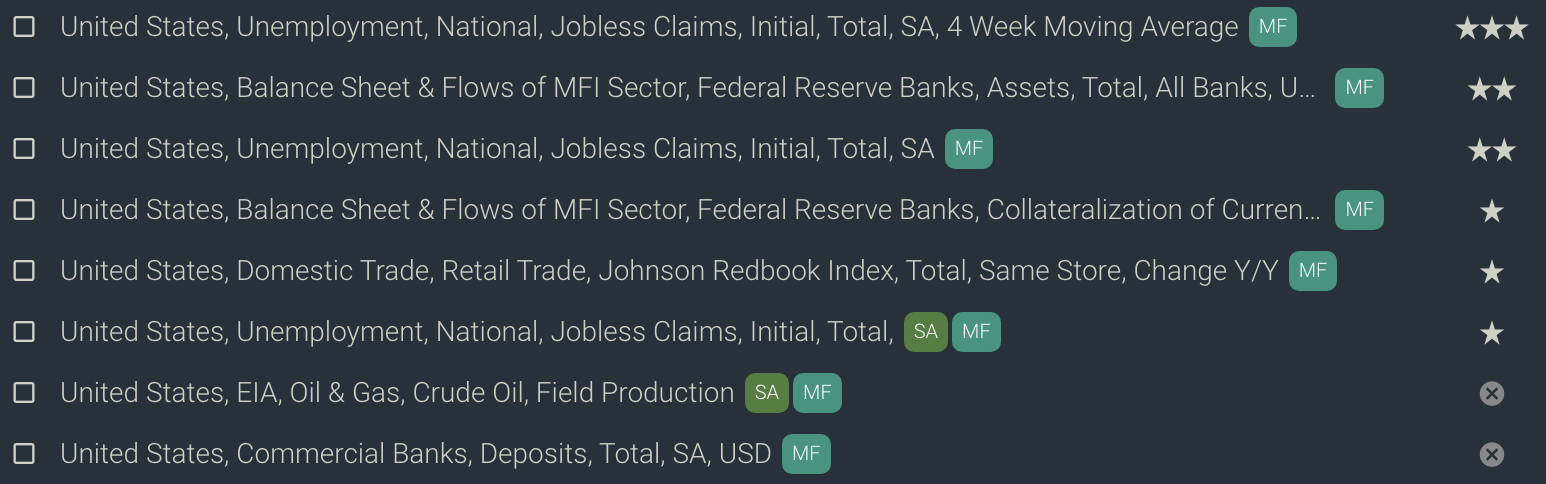
The selection is strong because it spans multiple channels that influence hiring, without stuffing the model with multiple versions of the same signal.
To make the model interpretable, here is how each indicator maps to a specific labor market signal.
1) Weekly layoffs signal: initial jobless claims
The indicator list includes initial jobless claims and a 4 week moving average. Claims are one of the fastest signals of layoffs and tend to lead payroll momentum, especially around turning points.
Why it works in a nowcast:
- it updates weekly
- it often shifts before payroll prints reflect hiring slowdowns
A practical detail: the 4 week moving average reduces noise and calendar effects, while the weekly series can catch abrupt changes earlier.
2) Weekly demand proxy: Johnson Redbook same store sales
The list includes Johnson Redbook same store sales YoY. Retail demand affects labor decisions quickly in consumer facing industries. Weekly same store sales can contribute near term signal for payrolls, particularly when consumer sentiment or spending momentum shifts.
3) Liquidity and financial conditions: deposits and Fed balance sheet measures
The list includes commercial bank deposits and Federal Reserve related balance sheet assets. These are not labor market series, but they help capture changes in liquidity and financial conditions that influence activity and hiring intentions.
For context, the Federal Reserve’s H.8 release covers assets and liabilities of commercial banks and is updated frequently. (Federal Reserve)
Why it matters for payrolls:
- tightening liquidity can precede reduced hiring
- easing conditions can support activity and labor demand
4) Real economy flows: rail intermodal units originated
Rail intermodal traffic is a high frequency read on goods movement and logistics. It often reacts to inventory cycles, demand shifts, and supply chain normalization. Those changes can spill into hiring across transportation, warehousing, manufacturing, and related services.
5) Sector overlay: crude oil field production
Energy sector dynamics can influence employment directly in energy linked regions and indirectly through capex and industrial activity. The indicator list includes crude oil field production, which can help the model reflect changes in that cycle.
What Indicio brings to nowcasting
Indicio is an automated forecasting platform designed to make advanced modeling usable without a large in house data science build out. The parts that matter most for a payroll nowcast are:
Mixed frequency models for real time forecasting
Indicio supports mixed frequency forecasting models commonly used for nowcasting, including MIDAS style approaches that translate weekly signals into a monthly nowcast.
Automated model building and backtesting
Indicio emphasizes automation and verification through backtesting and model comparison, so you can evaluate which specification performs best rather than selecting a model by intuition.
Explainable forecasting for stakeholder trust
Indicio includes explainability features that quantify and visualize which drivers push a forecast up or down, including contribution style views and SHAP style charts.
Together, these capabilities make nowcasting operational: you can refresh the model as new weekly releases arrive and still explain what moved.
How the model produces a January 2026 nowcast without hard coding assumptions
Indicio’s mixed frequency approach is designed for exactly this setup: weekly and monthly indicators are combined to produce a monthly estimate for the payroll change series. The platform’s MIDAS workflow is intended to use high frequency information to estimate upcoming lower frequency releases.
The output is a nowcast for the upcoming payroll print that updates as new weekly indicators arrive, not a manually adjusted number.
Latest nowcast versus market consensus
Indicio produces two useful views of the same nowcast. First, the best single MIDAS specification gives a point estimate for the January 2026 payroll change. Second, Indicio can generate a weighted nowcast that blends model outputs into one consolidated estimate.
In this run, the Indicio weighted nowcast for January 2026 is 64,014 jobs.
To benchmark it against the prevailing market view, the current consensus expectation is 70,000 jobs.
That puts the Indicio weighted nowcast 5,986 jobs below consensus, about 8.6% lower. The point is not to “beat consensus” for sport. The point is that a mixed frequency nowcast updates with weekly signals, and the weighted view gives planning teams a stable estimate that still reacts to new information, without overcommitting to a single model.
How to explain the nowcast to executives and planning teams
Indicio’s explainable forecasting features make a nowcast usable outside the analytics team because they connect the output to drivers stakeholders already understand. Indicio describes explainability in terms of quantifying each driver’s contribution and showing which factors act as drivers or barriers over the horizon.
For a payroll nowcast, the story usually falls into one of three patterns:
Pattern A: layoffs signal dominates - claims rise, and the nowcast drifts lower even if other activity series are stable.
Pattern B: demand softens first - same store sales and flow indicators weaken first, and claims follow later. The model often catches the shift early.
Pattern C: liquidity tightens - deposits and balance sheet measures deteriorate, activity indicators soften, and hiring responds with a lag.
A driver view lets you say not only what the nowcast is, but why it moved from last week to this week.
How to validate a nonfarm payroll nowcast
You cannot judge a nowcast by one print. The credibility comes from repeatable validation.
1) Pseudo real time backtesting
Test the model historically using only the data that would have been available before each payroll release date. Indicio supports out-of-sample scoring and model comparison as part of its model building workflow.
2) Stability checks
Remove one channel at a time and confirm the output does not collapse:
- remove claims
- remove demand proxy
- remove banking data
- remove flow indicators
A robust model degrades gracefully.
3) Driver sanity
Use explainability to confirm the model is not attributing payroll swings to nonsensical drivers. If signs flip constantly or contributions jump wildly, that is often a sign of overfitting.
Key takeaways
- Nonfarm payrolls are an ideal nowcast target because the print is monthly but the best signals arrive weekly.
- MIDAS models are built for mixed frequency setups and usually outperform approaches that rely on aggregating weekly data into monthly averages.
- In our model bake off (scored by MAPE), the best MIDAS model delivered a weighted out-of-sample result of 75% versus 89% for the non-MIDAS pool, highlighting the value of preserving high frequency information.
- Explainability is not optional if a nowcast is going to influence decisions. Indicio’s approach is to quantify driver contributions and make the model interpretable.
- The Indicio weighted nowcast (64,014) is below the Trading Economics consensus (70,000), and the difference is explainable through high frequency drivers.