No-code forecasting isn't just a tech trend; it's a fundamental shift in who gets to hold the steering wheel of a company’s strategy.
For decades, if you wanted a statistically rigorous forecast, you had to get in line. You’d submit a request to the data science team, wait three weeks for a model to be built in Python or R, and by the time you got the results, the market had already moved. This "gatekeeper" model of analytics has cost companies millions in missed opportunities and slow reactions.
The rise of platforms like Indicio is finally ending that bottleneck. By moving advanced econometrics and machine learning out of the terminal and into a visual interface, no-code forecasting is turning business analysts into "citizen data scientists."
The Death of the "Black Box"
One of the biggest hurdles for business users adopting AI has always been the "black box" problem. If a model tells a Demand Planner that sales will spike by 20% next month, but can’t explain why, that planner isn't going to risk their budget on it.
Indicio solves this by baking explainability into the core of the platform. Instead of just giving you a number, it uses SHAP (Shapley values) to show exactly which drivers are pushing the forecast up or pulling it down. Was it the marketing spend? A shift in the macroeconomy? Or perhaps a competitor’s pricing change?
When you can point to the specific drivers, you aren't just presenting a forecast; you’re telling a story that stakeholders can actually trust.
From Weeks to Minutes: The Automation of Rigor
What makes Indicio particularly interesting isn't just that it’s "easy to use" - it’s that it doesn't sacrifice statistical rigor for simplicity.
In a traditional workflow, a data scientist spends 80% of their time on data cleaning, outlier adjustment, and seasonal tuning. Indicio’s no-code engine automates that entire pipeline. With a few clicks, the platform:
- Cleans and adjusts data: Handles the "messy" parts of real-world datasets.
- Performs variable selection: Automatically identifies which leading indicators actually matter and which are just noise.
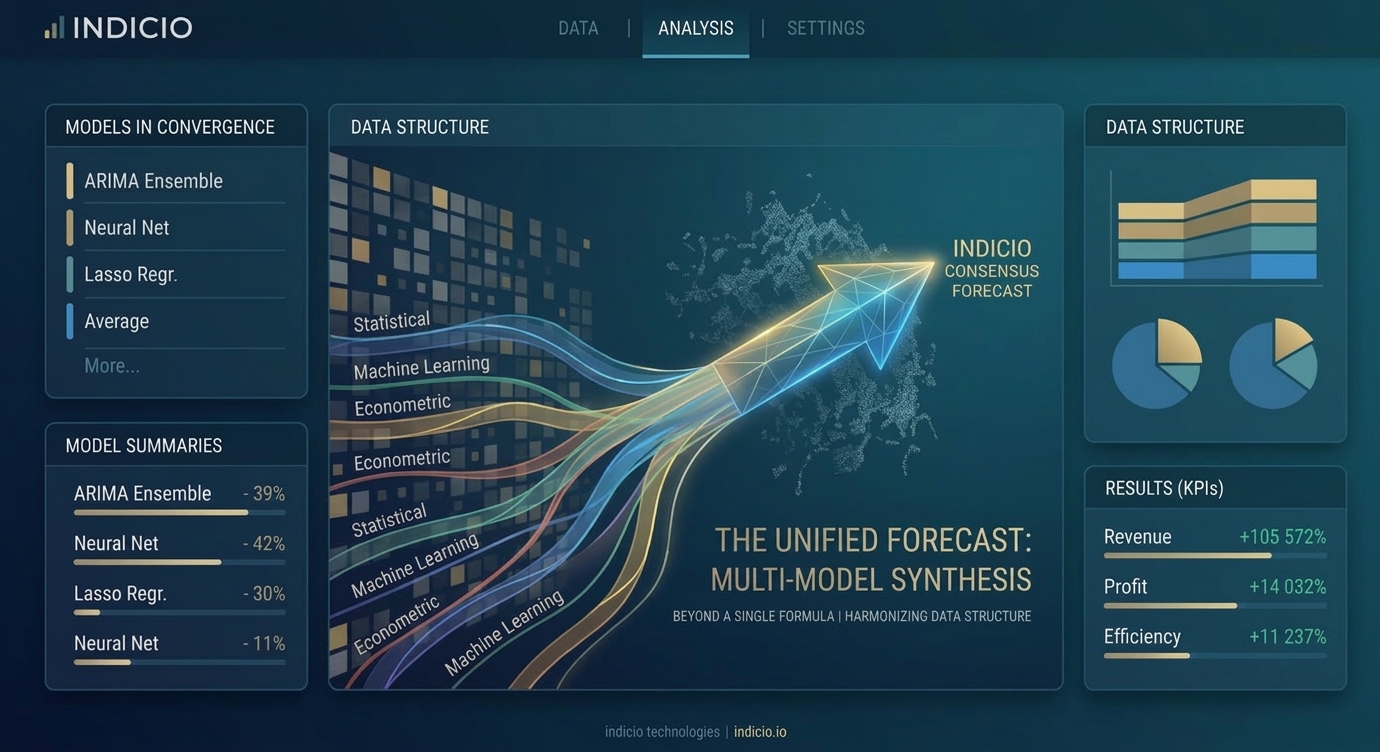
- Competes models: It runs hundreds of different models - from classic time-series to advanced LSTMs - and ranks them by accuracy.
This means a business user can produce a PhD-level forecast in the time it takes to grab a coffee.
The Power of "What-If"
The real magic of no-code forecasting happens when you move from predicting the future to simulating it. Indicio’s scenario analysis feature allows users to run "conditional forecasts."
What happens to our inventory if there’s a sudden port strike? What if interest rates drop by 50 basis points? By adjusting these drivers manually in the UI, business users can see the full probability distribution of outcomes instantly. This turns forecasting from a static report into a live planning tool.
Democratizing the Future
The goal of no-code isn't to replace data scientists; it’s to free them up for higher-level innovation while giving the people on the front lines the tools they need to make decisions in real-time.
When you empower a Supply Chain Manager or an FP&A Analyst to build their own models, you aren't just improving efficiency. You’re building a more agile, data-driven culture where "gut feel" is finally replaced by evidence-based direction.
In a world where market shifts happen in hours, waiting weeks for a forecast is no longer an option. No-code is the exit strategy every modern business needs.