The HVAR Own/Other Lasso model is an extension of the VARX Lasso model (see VARX Lasso) where a special hierarchical penalty is used. This penalty offers not only regularization to avoid over-fitting in terms of shrinking parameters towards zero, but also automatic selection of maximum lag order.
The HVAR Own/Other Lasso model allows selection of lag order per variable equation. Different variables in a VAR system may exhibit distinct temporal dependencies. Allowing variable-specific lag orders accommodates variations in the speed at which different variables respond to past values of themselves and other variables. This enhances the model's ability to capture the unique dynamics of each variable. The Own/Other part of the model implies own lags are shrunk by a smaller factor than other lags, i.e. the autoregressive properties of the included variables are prioritized over the effect of the different variables on each other. This is similar to the Minnesota prior by Litterman which is used in Bayesian analysis. Even in a setting where appropriate indicators are selected, it is common to see that the main variable is highly dependent on its own lags.
Mathematically, the penalty structure is defined for k variables and a maximum of pp lags as
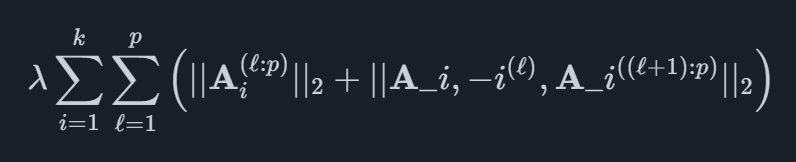
where the first term in the penalty is equivalent to the one in the HVAR Componentwise Lasso. The second term allows the lags of a variable in its own equation to be non-zero even if the same lag of the other variables is zero.