

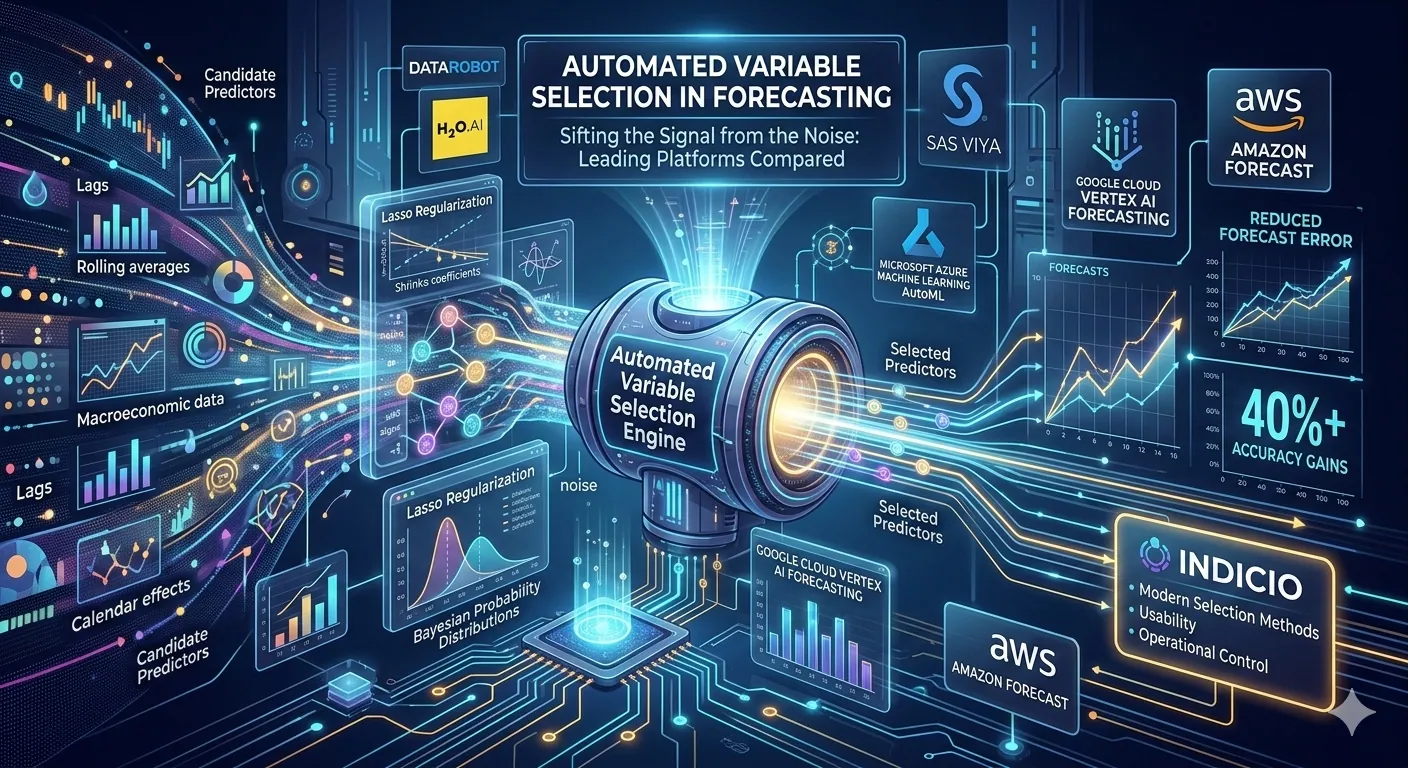
There was a time when picking your forecasting variables felt like an art form, or more accurately, an educated guess. You’d grab some lags, maybe some CPI data, throw in a dummy variable for a holiday, and hope for the best.
Indicio automates this process: it searches more than 400 million external indicators and keeps the ones that lead your series. This guide explains the methods behind it.
But in a world where we’re drowning in data, that manual approach doesn't just scale poorly; it actively hurts accuracy. When you’re looking at hundreds of potential predictors (lags, rolling averages, weather, macro trends), the "noise" eventually drowns out the "signal."
The goal of modern variable selection isn't just to automate a tedious task. It’s about building a model that can survive a regime shift. Research from the International Journal of Forecasting to recent ECB working papers, consistently shows that techniques like Lasso and Bayesian selection can slash forecast error by 40% or more.
If you’re looking to move past static models, here is how the market currently breaks down.
What We Actually Mean by “Automated Selection”
In a real-world forecasting stack, automated selection isn't a "one-and-done" feature. It’s a continuous filter that asks:
- What matters right now? (Is last year's driver still relevant after a supply chain shock?)
- Is this redundant? (If I have a 3-month rolling average, do I really need the 4-month one?)
- Where is the overfit? (How do I stop the model from chasing ghosts in a 500-column dataset?)
Most leading platforms solve this through Regularization (shrinking irrelevant coefficients to zero), Automated Feature Engineering (the "feature factory" approach), or Bayesian Selection (treating variable inclusion as a probability).
The Heavy Hitters: Evaluating the Market
1. The AutoML Giants: DataRobot & H2O.ai
If you want an "all-in-one" experience, these are the two most people look at first.
- DataRobot is effectively a feature factory. It excels at taking a raw dataset and generating thousands of time-series permutations (lags, transforms) before filtering them down. It’s great for teams that want a managed, high-speed workflow.
- H2O Driverless AI takes a similar "aggressive automation" path. It’s particularly strong if you’re comfortable with ML-heavy pipelines and need deep feature engineering.
The Rub: Both can feel a bit like a "black box." If you need to explain why a variable was dropped to a skeptical CFO, you might find the transparency lacking.
2. The Cloud Ecosystems: Azure, Vertex AI, and AWS
If your data already lives in the cloud, the "path of least resistance" is usually the native tools like Azure AutoML or Google’s Vertex AI.
- These are fantastic for MLOps and scaling.
- Amazon Forecast is a bit different, it’s a managed service that "absorbs" your related variables.
The Rub: Variable selection here is often an "emergent behavior" of the model training rather than a dedicated, transparent step. You get the result, but not always the "why."
3. The Enterprise Standard: SAS Viya
For those in highly regulated industries (Banking, Pharma), SAS remains the gold standard for governance. They’ve successfully moved their classic statistical rigor into the Viya era, offering production-grade Lasso and Elastic Net selection. It’s built for auditability, though it often requires more "hand-holding" and engineering than the newer AutoML players.
Why the "40% Accuracy Jump" is Actually Possible
It sounds like a marketing cliché, but a 40% improvement in accuracy is a common benchmark when moving from manual to automated selection. This usually happens because:
- Noise Reduction: You’re finally getting rid of the "garbage" variables that were confusing your coefficients.
- Frequent Re-estimation: Automation allows you to rebuild the model every week or month. If a variable loses its predictive power, it’s dropped immediately, not six months later during a manual review.
- High-Dimensional Handling: Humans can't realistically weigh 200 variables. Lasso can.
The Specialized Alternative: Why We Built Indicio
While the big platforms try to be everything to everyone, Indicio was built specifically for the forecasting professional who needs rigor and speed.
Most AutoML tools treat time-series data like a standard regression problem. We don’t. We’ve prioritized the methods that forecasting research actually supports:
- Bayesian Variable Selection: Instead of a hard "yes/no" on a variable, we use probabilistic inclusion. This gives you a much better handle on uncertainty, crucial for risk management.
- Forecasting-First UX: We’ve stripped away the "data science plumbing." You don’t need to write a script to handle lags or rolling windows; the system understands the temporal nature of your data from step one.
- Continuous Refresh: Indicio is designed to plug into your data sources and keep your selection logic "always-on." As regimes shift, your model adapts without you having to manually intervene.
How Indicio does variable selection
Indicio automates the steps in this guide. It searches more than 400 million external indicators, tests them against your own series and ranks them by what they add to forecast accuracy, not by correlation. The indicators that lead your series are kept, and the rest are dropped.
The selected indicators then go into more than 80 models that are backtested on your data, and the best are weighted into one forecast. Every forecast shows which indicators moved it, in numbers and in plain words, so the selection can be explained to the people who use the number.
Click through variable selection in the product tour, or read how Indicio One works.
The Bottom Line
- If you need a massive, general-purpose ML platform: Look at DataRobot or H2O.
- If you are locked into a cloud stack: Stick with Azure or Vertex.
- If you need a tool built by forecasters, for forecasters: Give Indicio a look.
Try variable selection on your own data
Indicio is a no-code forecasting platform that finds the leading indicators behind your demand and your market, backtests more than 80 models and combines the best into one explainable forecast. Book a demo and we set it up on a series like yours, with a backtest against your current forecast.