

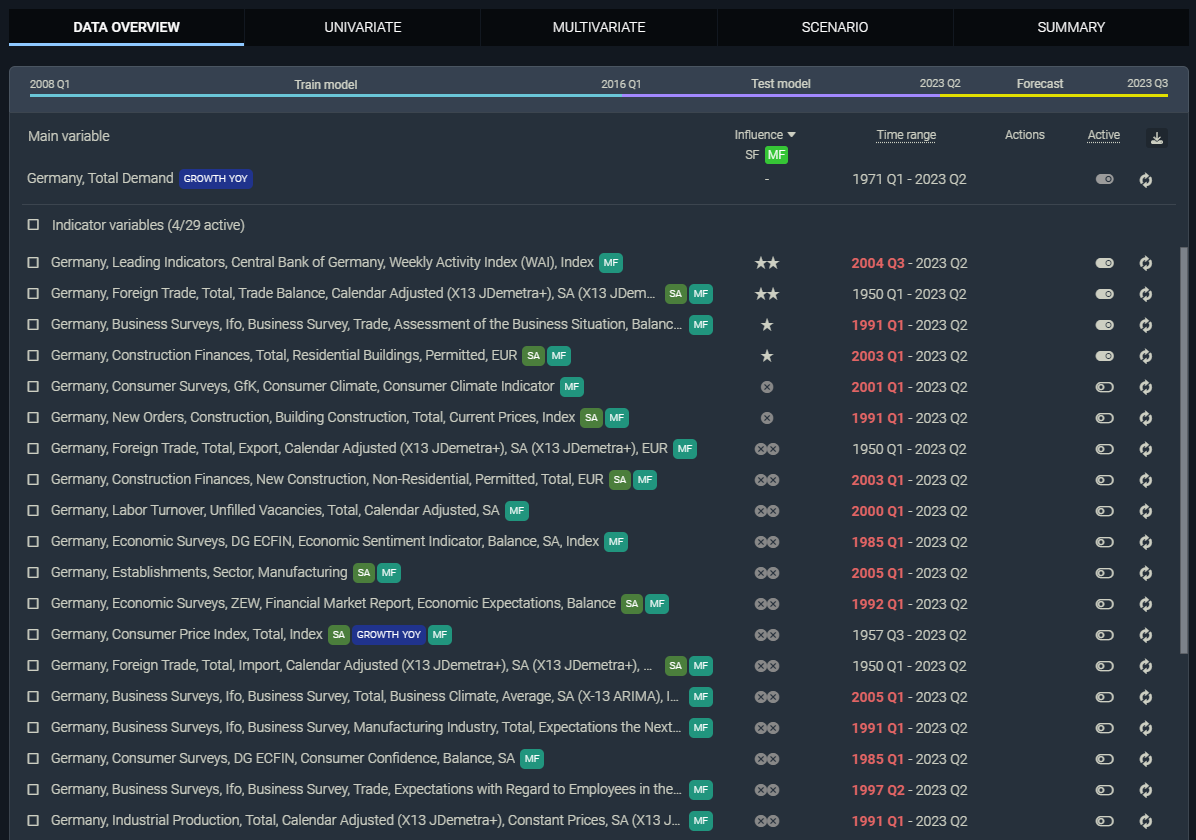
Demand forecasting software predicts how much of each product customers will buy, so that purchasing, production and inventory can be planned ahead. The tools below fall into two groups: planning suites that manage the whole plan, and forecasting engines that produce a better number and send it into the suite you already have.
In today’s fast-moving and volatile markets, demand planners face challenges that traditional forecasting approaches simply cannot handle. Forecasting models that only rely on internal company data, such as sales history, stock levels, or promotions, are no longer enough. Market shifts, economic developments, and external shocks often play a bigger role than anything visible inside your ERP or planning system.
Unfortunately, very few demand planning tools are built to incorporate these external signals. The result? Demand planners are left with blind spots that can cause costly mistakes. That’s why you don’t necessarily need a new demand planning software, you need a forecasting software that integrates seamlessly with your existing system. These solutions fetch historical data from your demand planning software, enrich it with external factors, and then export high-quality forecasts back into your workflow.
Below, we explore 8 of the best demand forecasting software platforms for demand planners in 2026.
The eight tools at a glance
| Tool | What it is | Best for |
|---|---|---|
| Indicio | Forecasting layer on top of your planning tool | Adding external market drivers and one reconciled number |
| SAS Forecast Server | Statistical forecasting at scale | Enterprises forecasting thousands of series |
| Blue Yonder Luminate Demand Edge | AI demand sensing | Retail and consumer goods |
| SAP IBP | Supply chain planning suite | Companies already running SAP ERP |
| o9 Solutions | Integrated business planning | Connecting demand, supply and financial planning |
| Oracle Demand Management Cloud | Part of the Oracle supply chain suite | Oracle supply chain users |
| Forecast Pro | Statistical forecasting tool | Mid-sized businesses |
| Anaplan | Connected planning platform | Custom planning models across finance, sales and supply chain |
How to choose demand forecasting software
- External drivers. Can the tool use market, economic and commodity indicators, or only your own sales history?
- Horizon. Weeks ahead is a different problem from 12 to 24 months ahead. Check which one the tool is built for.
- Fit with your planning system. Can it read your history and write the forecast back, or does it ask you to replace what you have?
- Explainability. Can planners see which drivers moved the number, so that they trust it in S&OP?
- Proof on your own data. Ask for a backtest against your current forecast before you commit.
The tools in detail
1. Indicio
Indicio adds a demand forecast for the months and years ahead to the planning tool you already use. It searches more than 400 million external indicators for the ones that lead your demand, backtests more than 80 models on your data and weights the best into one forecast, with the reason behind every number. With Indicio One, that forecast is reconciled with the operational forecast in your planning tool, so weeks add up to months and months to years. In peer-reviewed research on a global manufacturer’s data, leading indicators at the top of the forecast hierarchy gave 15% improved accuracy of the operational forecast (Sagaert & Kourentzes, 2025). The no-code interface and scenario analysis make it usable by planners, not only by data scientists.
Pros:
- Incorporates both internal and external drivers, with automated factor identification.
- No-code interface with advanced scenario simulations.
- Direct integrations with 20+ external data sources.
Cons:
- Higher cost compared to open-source forecasting packages.
- Does not allow custom-coded models.
- Requires a stable internet connection.
2. SAS Forecast Server
SAS Forecast Server is a long-standing solution trusted by enterprises with complex forecasting needs. It is particularly strong in handling large-scale datasets and running automated model selection across thousands of time series simultaneously. The software’s statistical depth ensures robustness, making it a common choice for organizations in retail, manufacturing, and utilities. However, its learning curve and reliance on technical expertise make it less accessible to teams without a strong analytics background.
Pros:
- Handles very large-scale forecasting across thousands of series.
- Deep statistical rigor and automation for model selection.
- Enterprise-grade support and reliability.
Cons:
- Steep learning curve; requires advanced skills to use effectively.
- Interface is less modern and user-friendly compared to newer tools.
- Licensing and support costs can be high.
3. Blue Yonder Luminate Demand Edge
Blue Yonder’s Luminate Demand Edge is built specifically for retail and consumer goods, offering AI-powered forecasts that adapt quickly to demand signals. It integrates internal transactional data with causal factors like weather, promotions, and holidays to provide more accurate insights. Luminate’s cloud-native architecture and real-time processing make it especially strong for businesses dealing with rapid demand fluctuations. However, it is more limited in economic and market-level external data integrations compared to dedicated forecasting platforms.
Pros:
- Strong AI-driven demand sensing capabilities.
- Tailored for retail and consumer goods industries.
- Cloud-native, scalable, and real-time ready.
Cons:
- Primarily optimized for retail use cases, less flexible for other industries.
- Limited integrations with broader macroeconomic data sources.
- Implementation costs and time can be significant.
4. SAP Integrated Business Planning (IBP)
SAP IBP is one of the most widely adopted demand planning solutions, especially among enterprises already running SAP ERP. Its demand forecasting capabilities are built into a broader supply chain planning suite, offering strong collaboration and integration features. While SAP IBP is excellent at aligning demand with supply and financial planning, its native forecasting engine is relatively limited to internal data. Companies often pair IBP with external forecasting software to enrich its capabilities.
Pros:
- Deep integration with SAP ERP and supply chain modules.
- Strong collaboration and workflow management.
- Good for aligning demand forecasts with financial and supply planning.
Cons:
- Native forecasting is limited and often too simplistic.
- Heavy reliance on SAP ecosystem; limited flexibility.
- High total cost of ownership.
5. o9 Solutions
o9 Solutions offers a digital brain for integrated business planning, with AI-driven forecasting capabilities. It emphasizes connecting demand, supply, and financial planning while enabling scenario planning across different horizons. The platform integrates a variety of data sources, but it focuses more on internal business drivers and structured data rather than external macroeconomic or alternative datasets. While powerful, o9 often requires customization and long implementation projects.
Pros:
- Strong scenario planning and digital twin capabilities.
- Comprehensive integration of demand, supply, and finance.
- AI and analytics embedded across the platform.
Cons:
- External data coverage is limited compared to specialized forecasting tools.
- Implementation can be lengthy and resource-intensive.
- Costs are high for mid-sized businesses.
6. Oracle Demand Management Cloud
Oracle Demand Management Cloud is part of the Oracle Supply Chain Management suite. It provides statistical and machine learning–based forecasting, with built-in collaboration and demand sensing features. Its strength lies in integrating demand forecasts with supply and operations planning. However, while it includes causal factors such as promotions or seasonality, it does not natively cover wider macroeconomic or market datasets. Organizations often need to feed it enriched forecasts from external platforms.
Pros:
- Robust statistical and ML-based forecasting models.
- Strong integration with Oracle SCM ecosystem.
- Good demand sensing and collaboration features.
Cons:
- Limited support for external macroeconomic drivers.
- Requires Oracle ecosystem buy-in for maximum value.
- Can be complex to configure and maintain.
7. Forecast Pro
Forecast Pro is a well-established forecasting solution known for its accessibility and depth of statistical models. It is particularly popular among mid-sized businesses and academic users. The tool makes it easy to build forecasts with time series methods and causal models, though it requires manual work to incorporate external drivers. While not as flashy as newer AI-driven platforms, Forecast Pro offers a practical balance of functionality and affordability.
Pros:
- Wide range of statistical models with transparent methodology.
- Relatively easy to learn and use.
- More affordable than most enterprise solutions.
Cons:
- Limited automation compared to modern AI tools.
- Weak integrations with external data sources.
- Not as scalable for very large organizations.
8. Anaplan
Anaplan is best known as a connected planning platform that supports financial, sales, and supply chain planning. Its demand forecasting capabilities are flexible thanks to its modeling environment, allowing teams to build customized planning workflows. Anaplan is strong in cross-functional collaboration, but its forecasting strength depends on what users build themselves. External factor integration is possible but usually requires manual setup or third-party connectors.
Pros:
- Highly flexible and customizable modeling environment.
- Strong collaboration across business functions.
- Cloud-based and scalable.
Cons:
- Out-of-the-box forecasting features are limited.
- Setup and maintenance require significant expertise.
- External factor integration is not automated.
Final Thoughts
Choosing the right demand forecasting software isn’t about replacing your demand planning system, it’s about enhancing it. Tools like Indicio stand out by incorporating both internal and external drivers, giving planners a sharper view of the future. Others, like SAP IBP or Oracle Demand Management Cloud, excel at integration and workflow but rely on enriched forecasts from specialized forecasting engines.
In volatile markets, the difference between a forecast built on internal history alone and one enriched with market, economic, and external data can be the difference between being blindsided and staying ahead.
Frequently asked questions
What is demand forecasting software?
Demand forecasting software estimates future demand for products or services from historical sales and, in more capable tools, from external drivers such as economic indicators, prices and market activity. The forecast is then used for purchasing, production, inventory and financial planning.
What is the difference between demand planning and demand forecasting software?
Demand planning software manages the whole planning process: collaboration, inventory targets, supply plans and approvals. Demand forecasting software produces the number that the plan starts from. Many companies keep their planning system and add a specialised forecasting engine on top of it.
Do I need to replace my planning system to get better forecasts?
No. A forecasting layer can read history from your planning system or ERP, build the forecast outside it and write the result back, so planners keep working in the screens they know.
How do external indicators improve a demand forecast?
Leading indicators, such as new orders, construction permits or commodity prices, move before your own demand does. A model that uses them can see a turn in the market months before it shows up in your order history.