STL is a versatile and robust method for decomposing time series. STL is an acronym for “Seasonal and Trend decomposition using LOESS”, while LOESS is a method for estimating nonlinear relationships.
The STL model works by dividing a time series Yt into three components as
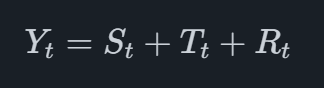
where StSt is the seasonal component, Tt is the trend component and Rt is the remainder, or random component which cannot be described as part of the season or trend. The model is estimated using LOESS which is an abbreviation of locally estimated scatterplot smoothing. It works by at each point in the data fitting a low order polynomial to the current point and those nearby. This enables it to fit a smooth curve that follows the data closely.
To use an STL model for forecasting, the seasonal component is removed from the data and an ARIMA(1,1,0) (see ARIMA) model is used to forecast the non-seasonal series, finally, the seasonal component is added back to the forecast.